Timber is a natural material, which is part of what makes it such a popular choice for fencing, decking, landscaping and outdoor projects. But being natural also means that timber does not remain exactly the same throughout the year.
As we move into autumn and wetter weather becomes more frequent, you may notice changes in timber around your garden. A gate that opened freely in summer may suddenly feel a little tighter. Gaps between decking boards can change. Small cracks may appear in sleepers or fence posts, while some boards can develop a slight curve or twist.
These changes do not automatically mean there is something wrong with the timber. In many cases, they are simply the result of natural timber movement as wood gains and loses moisture.
So, why does timber swell, shrink and sometimes warp? And, more importantly, when is timber movement normal and when should you be concerned?
Timber naturally exchanges moisture with its surroundings.
When conditions become wetter or more humid, the moisture content of the wood can increase and the timber may swell. When conditions become drier, timber loses moisture and shrinks.
This process continues throughout the life of the timber, even if it has previously been kiln dried. Coatings and treatments may help slow the rate at which moisture moves in and out of the wood, but they do not stop natural timber movement completely.
For outdoor timber, these changes can be particularly noticeable because it is exposed to rain, sunshine and changing atmospheric conditions throughout the year.
During warmer, drier periods, outdoor timber often has more opportunity to lose moisture.
As autumn arrives, wetter conditions and fewer opportunities for the timber to dry between periods of rainfall can cause its moisture content to increase. As a result, the timber may expand slightly.
You might notice this in places such as:
Timber generally moves much more across its width than along its length. This is why changes in the width, shape or spacing of boards are usually more noticeable than changes in their length.
Not usually. The most noticeable seasonal movement in timber is caused by changes in moisture content rather than cold temperatures alone.
Outdoor timber may swell during autumn and winter because these months often bring wetter conditions and less opportunity for the wood to dry.
This is also why timber does not always behave the same way simply because it is winter. Timber kept indoors in a warm, centrally heated building can actually lose moisture and shrink during colder months because the surrounding air is relatively dry.
If outdoor timber has swollen during prolonged wet weather, some of that movement will usually reverse as conditions become drier. However, timber should not always be expected to return to exactly the same shape, particularly if more significant bowing or twisting has developed.
Why Does Timber Shrink?
The opposite happens when timber dries.
As moisture leaves the cell walls, the timber contracts. This can become particularly noticeable following a prolonged period of warm or dry weather.
You may see:
This does not necessarily indicate a fault. The same piece of timber may expand during wetter periods and contract again as conditions become drier.
Not every part of a piece of timber moves by exactly the same amount.
Wood shrinks and swells differently depending on the direction of its grain, how it was cut and how evenly it gains or loses moisture. When movement is uneven, the timber can change shape. This is what we commonly describe as warping.
Different types of timber movement include:
The timber species, dimensions, grain pattern and drying conditions can all influence how much movement takes place.
Minor movement caused by temporary moisture differences may reduce as the timber dries and its moisture content becomes more even. However, more pronounced bowing, twisting or cupping may remain, so warped timber should not always be expected to straighten completely on its own.
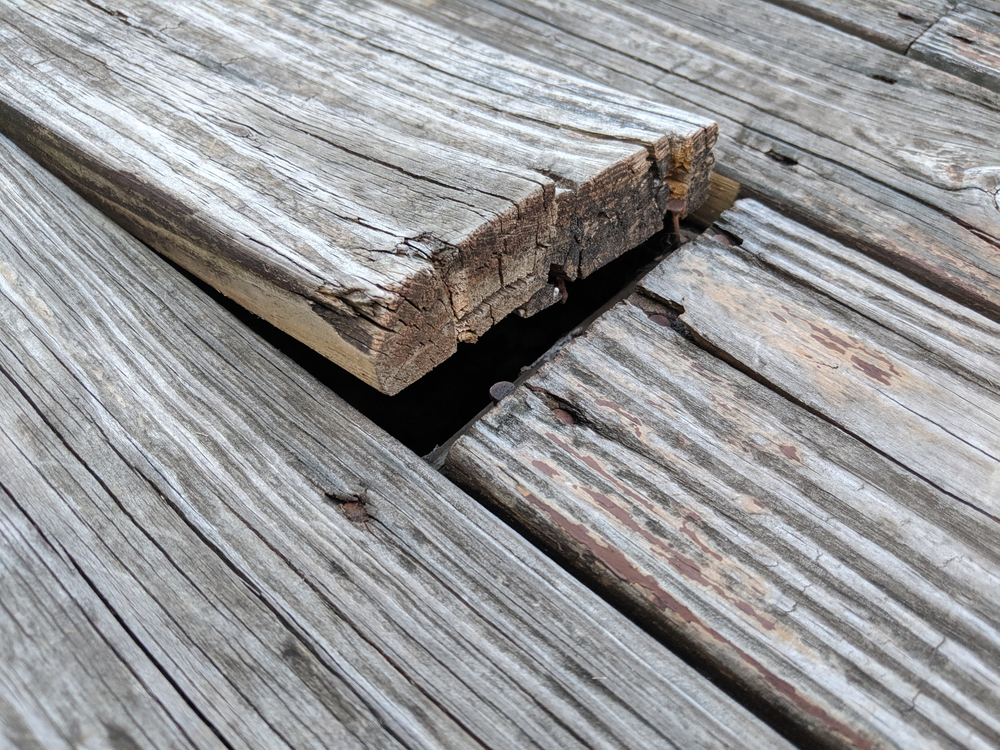
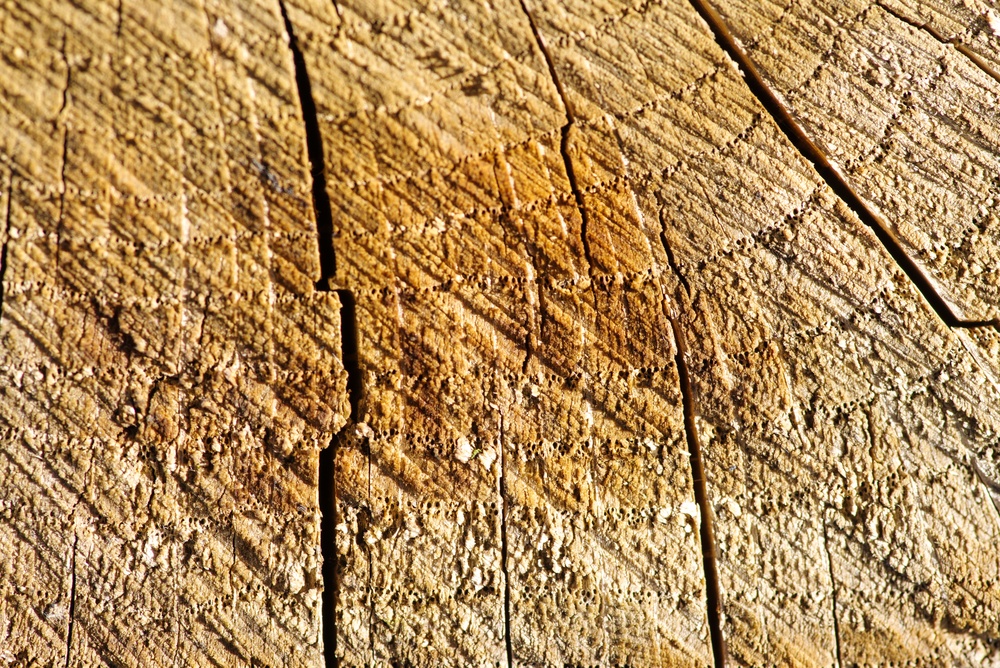
Cracks in outdoor timber are often known as checks and are particularly common in thicker sections such as fence posts and sleepers.
They can form as timber dries, because the outer surface may lose moisture and shrink more quickly than the wood deeper inside. This creates stresses within the timber and can cause checks to appear along the grain.
This can happen even in new, properly processed timber. Wood continues to respond to changes in moisture after it has been sawn, treated or installed, and pressure treatment does not prevent this natural movement.
Checks may also change with the weather, becoming more noticeable in dry conditions and appearing to close slightly as the timber takes on moisture again.
A small check does not automatically mean the timber is faulty or has lost its strength. However, very large or deep splits, severe distortion, signs of decay, damage around fixings or movement affecting the structural performance of the timber should be investigated.
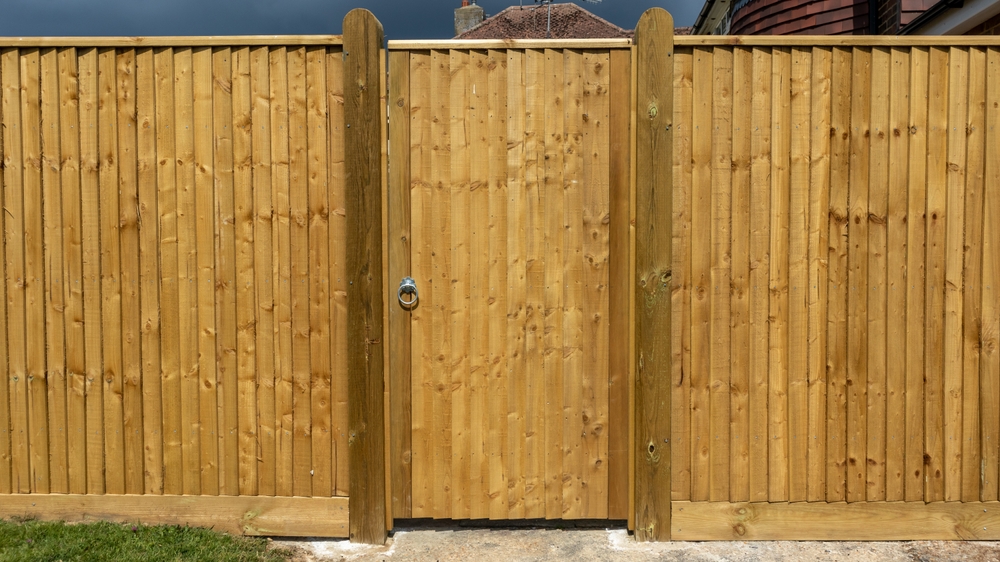
A gate that suddenly becomes difficult to open during wet weather is a common example of seasonal timber movement.
The timber within the gate may have absorbed additional moisture and expanded slightly. Even a relatively small dimensional change can become noticeable where there is limited clearance between the gate and its post.
However, swelling is not the only possible cause.
Before cutting, sanding or planing your gate, check:
If the timber has temporarily expanded because of wet conditions, removing too much material immediately could create an unnecessarily large gap when the gate dries and contracts again.
Minor adjustments to hinges or fixings may sometimes be a better first step.
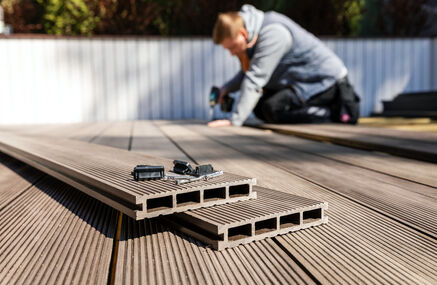
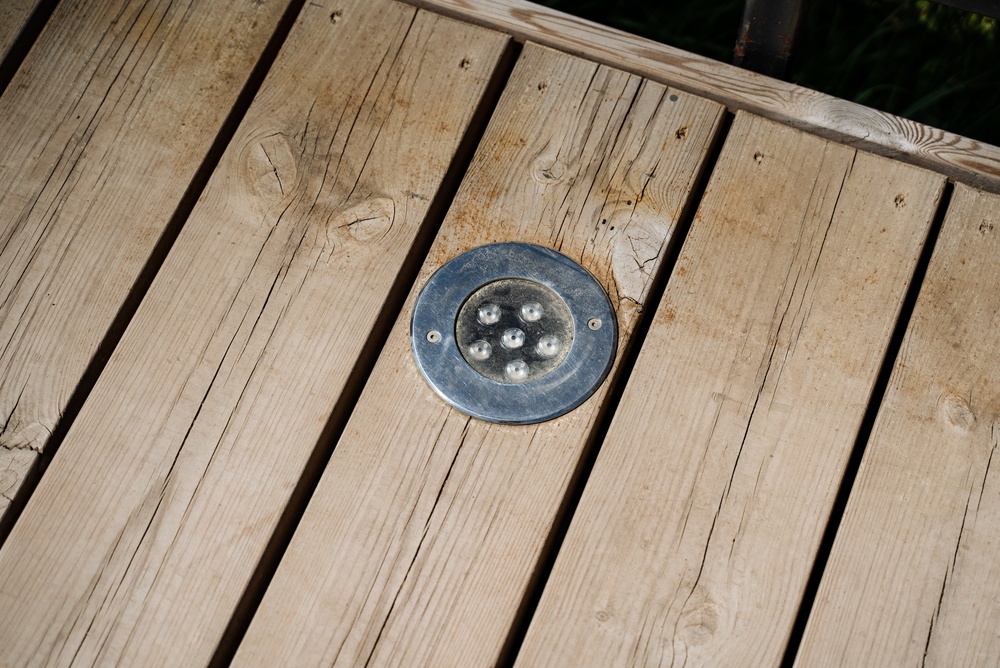
Decking provides another easy-to-see example of timber movement.
Timber decking boards naturally expand and contract across their width as their moisture content changes.
A board installed while relatively wet may become slightly narrower as it dries, increasing the gaps between neighbouring boards. During prolonged wet weather, the boards may take on more moisture and expand, reducing those gaps.
This is one reason why suitable spacing is important when installing timber decking. It provides room for natural movement while also helping water drain away from the deck.
There is no single spacing measurement suitable for every installation. The correct gap can depend on the timber, its moisture content when installed and any manufacturer or supplier guidance.
If you are planning a new deck, take a look at our guide on How To Lay Decking in 10 Easy To Follow Steps for more installation advice.
Yes. Pressure-treated timber has been treated with preservative to improve its resistance to threats such as fungal decay and wood-boring insects. However, the treatment does not make timber completely waterproof or prevent natural movement.
Treated timber will still gain and lose moisture as conditions change, so some swelling, shrinkage and checking can still occur.
Likewise, kiln drying does not mean that timber will remain at the same moisture content forever. Once exposed to different conditions, it will gradually adjust to its surroundings.
Seeing seasonal movement in treated timber does not therefore mean that the treatment has failed.
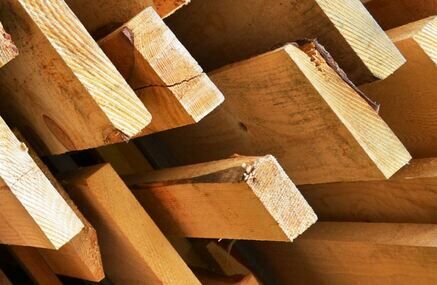
How timber is stored before use can influence how much unwanted movement or distortion occurs.
Where possible, timber should be kept flat, supported and off the ground. Longer lengths should have sufficient support along their length rather than being left leaning unsupported for long periods.
Timber should also be protected from prolonged rain and uneven exposure to strong sunlight. Good airflow is important, so avoid tightly wrapping damp timber or storing it where moisture can become trapped.
For best results:
Good storage will not stop timber moving completely, but it can help reduce unnecessary distortion before installation.
Not completely, and generally you should not try to. Instead, timber projects should be designed and installed with natural movement in mind.
Allow suitable spacing where required, use appropriate exterior-grade fixings and make sure boards are adequately supported. Good drainage is also important, as timber should not be unnecessarily exposed to standing water for prolonged periods.
Where pressure-treated timber is cut, freshly exposed ends should be treated with a suitable end-grain preservative where required by the product guidance.
Exterior stains, oils and other suitable finishes may also help slow the rate at which timber absorbs and releases moisture, although they will not completely prevent natural expansion and contraction.
Because timber is a natural material, perfect dimensional stability should not be expected.
The important thing is understanding the difference between normal seasonal movement and a problem that may require attention.
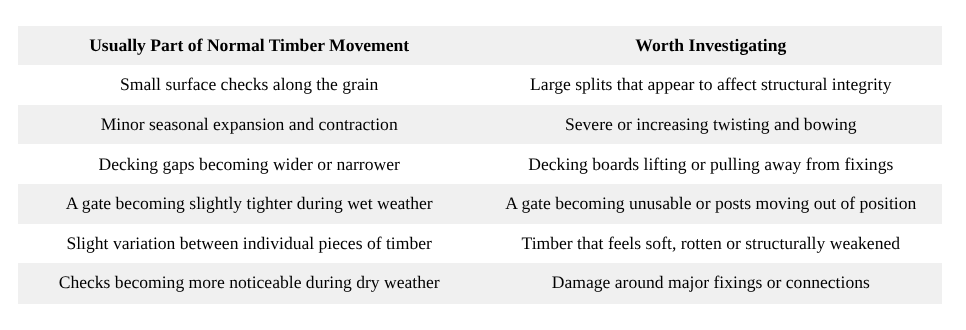
If you are unsure whether the movement you are seeing is normal, it is worth getting advice before cutting, replacing or making major alterations to the timber.
Timber will naturally respond to changing moisture levels throughout the year. Understanding what normal movement looks like, allowing for it during installation and storing and maintaining timber correctly can all help prevent those changes from becoming a problem.
Whether you are repairing a fence, building a new deck or planning a landscaping project, KPT Timber stocks a wide range of timber, fencing and landscaping products for projects across Devon and Cornwall.